


I’ve been putting this one off.
Not because the argument is hard to make – it isn’t – but because the behavior it’s about has been a fixture of the SEO industry for as long as I’ve worked in it. The shiny new object arrives, the FOMO kicks in, the conference decks update, and an entire professional class reshuffles its vocabulary to match whatever acronym landed that quarter. I wrote recently about how AI content scaling is just content spinning with better grammar – the tools change, the qualitative wall doesn’t. The acronym cycle runs on the same engine.
But this time, the shiny object didn’t emerge from practitioners observing a genuine shift and trying to name it. It was manufactured upstream – by venture capital, amplified by engagement farming, and adopted by professionals whose primary motivation isn’t “this is real” but “I can’t afford to look like I’m not keeping up.”
So here we are.
The Investment Thesis
In May 2025, Andreessen Horowitz published a blog post titled “How Generative Engine Optimization (GEO) Rewrites the Rules of Search.” It appeared in their enterprise newsletter, written by two a16z partners, Zach Cohen and Seema Amble. Public, on their website, available to anyone with a browser.
The post declared that the “$80 billion+ SEO market just cracked” and that “a new paradigm is emerging.” It name-dropped three GEO tools – Profound, Goodie, and Daydream – as platforms enabling brands to track how they appear in AI-generated responses. It described a future where GEO companies would “fine-tune their own models” and “own the loop” between insight and iteration. a16z promoted it across their social channels, including a post from the firm’s official account: “SEO is slowly losing its dominance. Welcome to GEO.”
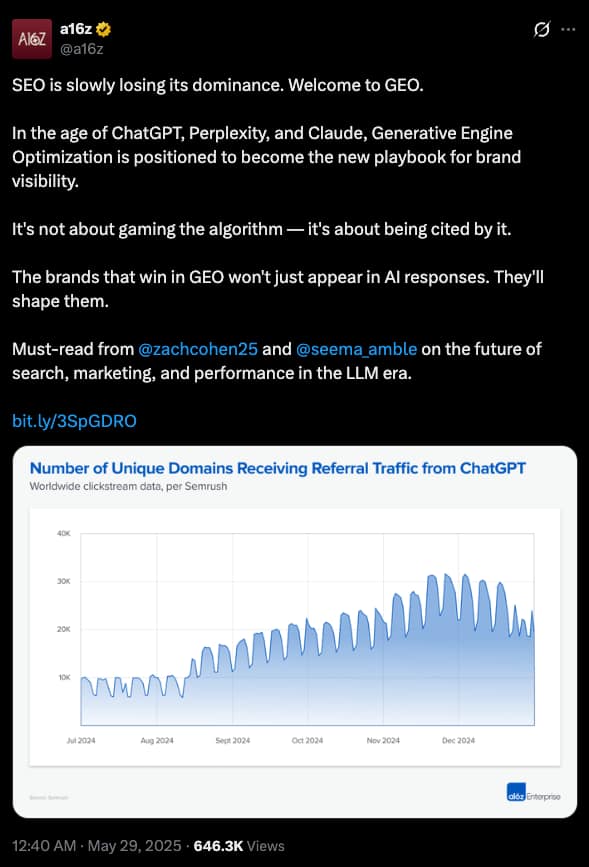
Also: a16z is an investor in Profound.
The blog post creates demand for the category. The category creates demand for the tools. The tools are in their portfolio. A sales funnel with a byline.
Marc Andreessen’s “Software is eating the world” wasn’t just an essay – it was a prospectus dressed in editorial clothing. The GEO post follows the same logic: identify the wave, position your bets as the inevitable response, publish the narrative that makes both feel like settled truth. Even sympathetic coverage noticed. The Alts.co write-up noted plainly that “a16z is drawing attention to GEO because it’s a chance to peddle/pump their own investments.”
What Happens When Nobody Checks The Source
Ten months later, in March 2026, someone on X described the blog post as “a 34-page internal memo” that a16z had “quietly published” and which had received only “200 views.” It cited a specific statistic: portfolio companies ranking No.1 on Google saw “a 34% drop in organic traffic in 12 months.” I’m not interested in the individual. This post is one of hundreds following the same pattern, and the pattern is what matters.
None of this is real.
The blog post isn’t 34 pages. It isn’t internal. It wasn’t quietly published. The specific opening line and the 34% stat don’t appear in the actual piece. You can verify this yourself right now.
This isn’t a16z’s doing. An engagement farmer found an old blog post and repackaged it with fictional scaffolding because that format performs better on social media. A “leaked internal memo” is sexier than a newsletter. “200 views” creates scarcity. Invented statistics create authority.
And it worked. People shared it, built threads around it, didn’t check whether the memo existed. Why would they? The narrative was too good.
Two independent forces – a VC firm doing standard narrative-building, and an engagement farmer doing standard engagement farming – converge on the same result. The VC seeds the category. The farmer, months later, independently amplifies a distorted version. Professionals absorb the distortion because nobody goes back to check the primary source.
Not coordination. Convergence. And a category becomes “real” without anybody establishing that it is.
The Willing Participants
VCs and engagement farmers can’t take all the credit. SEO professionals are the most culpable link in the chain.
One widely-shared post on X captures the mentality – and I’m citing the behavior, not the person, because this position is everywhere in the industry right now. The argument: Clients don’t want to hear that GEO is “just SEO repackaged.” Neither does your executive team. Tell them “it’s just SEO,” and you’ll be “perceived as a legacy outdated thinker.” You might even be “replaced by a GEO agency.” The conclusion: “whether you like it or not… it’s in your best interest to get aboard the AI train.”
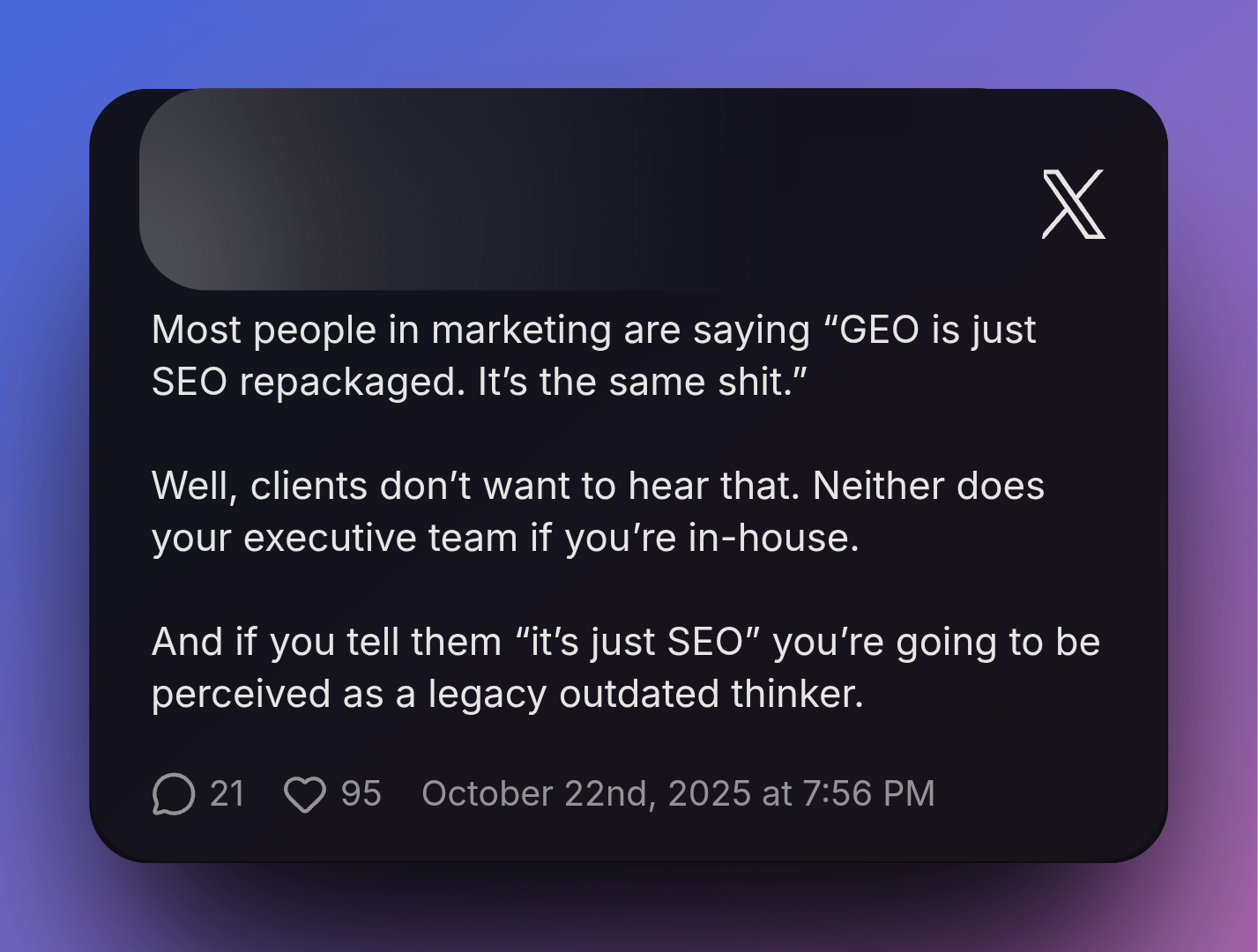
The argument is not that GEO works. Not that it measures anything meaningful. Not that it produces better outcomes for clients. The argument is that if you don’t adopt the label, you will lose your job.
Ambulance chasing dressed as career advice.
And here’s what makes SEO professionals more culpable than the VCs or the engagement farmers: they don’t just absorb the fear. They market it. They repackage the anxiety about their own relevance and sell it downstream to clients and executives who are even less equipped to evaluate the claims. The VC creates the narrative. The engagement farmer amplifies it. The SEO professional walks into a client meeting and says, “You need a GEO strategy, or you’ll be invisible to AI,” knowing full well they can’t define what that means in terms the client could verify.
This is how SEO professionals undermine their own credibility. Not by being wrong about the technical shift, but by selling certainty they don’t have about a category they didn’t bother to verify, using someone else’s terminology to paper over their own lack of understanding.
Nobody held a gun to anyone’s head and said, “Put GEO on your LinkedIn headline.” SEO professionals are choosing to adopt terminology they haven’t evaluated, from sources they haven’t verified, for tools they can’t validate; and then surfing that same fear factor into client budgets. If the only way you can sell your expertise is by rebranding it every eighteen months, the problem isn’t the label. It’s the confidence.
The people most capable of evaluating whether GEO is a real discipline are the same people adopting it fastest. Every hour they spend chasing the vocabulary is an hour not spent building the understanding that would make them impossible to replace. I’ve written about how AI is hollowing out the junior pipeline: the apprenticeship layer where practitioners actually learn judgment. The acronym treadmill accelerates that. It replaces depth with breadth, understanding with terminology, and professional development with professional performance.
What’s Actually Underneath
Strip away the a16z framing, the fabricated memos, and the professional anxiety, and ask the boring question: what would you actually do differently if you took GEO seriously?
I’ve argued before that grounding is just retrieval: When an AI system cites a source, it’s running a search task, not exercising editorial judgment. Indexing, vector search, relevance scoring. The same principles we’ve been working with for two decades, with a generative interface on top. GEO isn’t a second discipline standing alongside SEO. It’s old retrieval visibility in a trench coat pretending to be two disciplines. And your data interpretation skills – perched comfortably atop Mount Dunning-Kruger – don’t trump the clear, demonstrable logic of how a retrieval engine works. If you can’t explain why a result appeared, you have no business selling a service that claims to optimize for it.
The a16z post itself confirms this, perhaps accidentally. The advice it gives brands pursuing GEO is a greatest hits of SEO best practices: structured content, authoritative backlinks (rebranded as “earned media”), schema markup, topical authority. It even recommends “short, dense, citation-worthy paragraphs” and “specific claims with verifiable numbers” – which is, and I cannot stress this enough, just competent writing.
David McSweeney has been doing SEO since before some of these GEO startups’ founders graduated. He’s spent years writing about the same tactics now being repackaged under the GEO label (content freshness, digital PR, community participation, link building) and has the publication dates to prove it. His summary of the GEO pitch: take advantage of the fact that businesses don’t understand AI systems rely on traditional search, and extract more money from them.
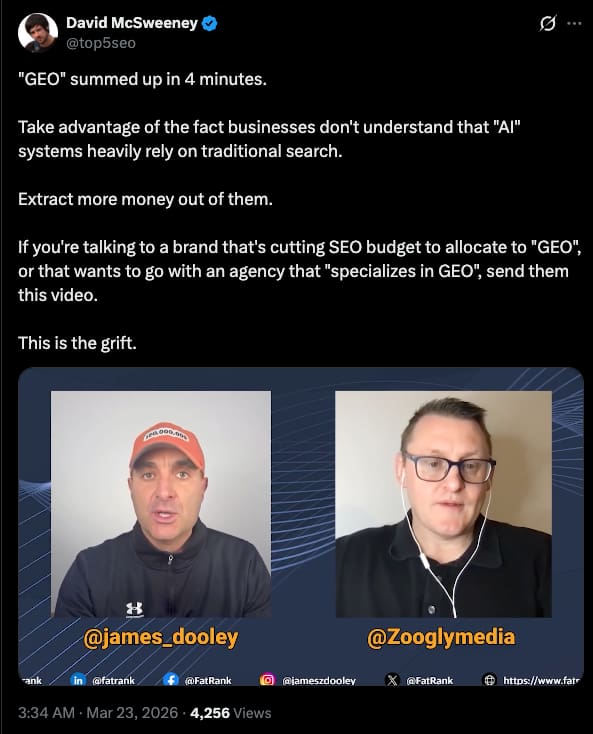
He called it the grift. I think that’s generous. A grift implies individual con artists. This is structural: a category manufactured at the top, distorted in the middle, and adopted at the bottom. Not because it describes anything new, but because the professional cost of ignoring it feels higher than the professional cost of pretending it’s real.
You’re Not In The Driver’s Seat
Your job as a competent professional is to understand what these abbreviations actually mean, where they come from, and what – if anything – they change about your work.
If you can explain to your clients and your leadership what AI systems actually do, how they retrieve information, what’s genuinely measurable, and what isn’t – you will never be in a reactive position. You will never be the person scrambling to add “GEO” to a slide deck because someone on X told you it was the future.
If instead you let yourself be dragged around by whatever narrative venture capitalists need you to believe this quarter, you will always be reacting. One blog post away from a strategy pivot. Buying tools sold by people who benefit from your insecurity. That’s a choice. Not a fate.
The underlying mechanics of how content gets discovered – search engine crawler, LLM grounding system, RAG pipeline – haven’t undergone a paradigm shift. The interface has shifted. Users get answers synthesized from sources rather than a list of links.
But “the interface changed” doesn’t sell software. “Everything you know is obsolete and you need our dashboard” does.
Follow The Money
a16z benefits because the GEO narrative creates demand for their portfolio companies. The tool startups benefit because the narrative creates their market. The engagement farmers benefit because fabricated memos drive impressions. The agencies that rebrand as “GEO specialists” benefit because they can charge more for the same services with a shinier label.
Who doesn’t benefit? The practitioners doing solid, foundational work. Those people don’t need a new acronym. They need the industry to stop mistaking marketing for methodology.
And the clients. The clients are where the fear chain terminates, and the invoices begin. A new line item for work that should have been happening already under the SEO retainer, or that can’t be reliably measured in the first place. The VC manufactures the category. The SEO professional absorbs it and marks it up. The client pays for it. A game of telephone where the bill lands on the last person in the room who doesn’t speak the language.
I’ve written separately about the measurement problem with these tools – the non-determinism, the gap between parametric and retrieved knowledge, the dashboards built on methodological sand. The tools a16z promotes in that blog post have the same structural limitations. The dashboards look great. The numbers move. Whether the numbers mean anything is a question nobody selling the dashboard has an incentive to answer.
Meanwhile, the actual crisis gets no airtime. Organic search traffic across major U.S. publishers dropped 42% after AI Overviews expanded. Rankings didn’t change. Traffic did. That’s the real problem. Not which three-letter acronym to put on your slide deck, but the fact that the economic model underpinning content production on the open web is breaking. GEO doesn’t address that. It doesn’t even pretend to. It just gives everyone something to be busy with while the floor drops out.
The cycle time is getting shorter. We went from “AEO” to “GEO” in about eighteen months. Give it another year, and there’ll be another acronym, another VC blog post, another fabricated memo, and another round of professionals trying to decide whether the latest three letters are worth putting on their LinkedIn headline.
Or you could just do good work and understand what you’re doing well enough to explain it without borrowed terminology. But I suppose that doesn’t have the same ring to it on a pitch deck.
More Resources:
This post was originally published on The Inference.
Featured Image: Summit Art Creations/Shutterstock