


A discussion on Twitter about the many people posting that they’ve left WordPress for Astro went modestly viral, with longtime WordPress supporters explaining why they ditched WordPress for Astro. Statistics show that WordPress is losing users and Astro is gaining them at a rate of 100% year over year, indicating that the shift toward Astro is more than a passing trend.
WordPress Marketshare Steadily Declining
An underreported statistic about WordPress is that WordPress peaked in mid 2025 with a marketshare of 43.6% and has been on a steady decline ever since, currently sitting at a 42.2% marketshare (according to W3Techs), a drop of 1.4%. WordPress is losing marketshare, this is a fact.
An argument could be made that the WordPress marketshare percentage is inflated because a significant number of WordPress websites are abandoned or spam. The official WordPress statistics show that 10.56% of WordPress websites haven’t been updated since 2022. That means, if you don’t count abandoned websites, the actual WordPress marketshare is less than the 42.2%.
Astro Downloaded 2.5 Million Times Per Week
Astro is a static site generator and web framework. It’s not a content management system, it is software that generates websites from content. Sites created with Astro are called static because they are classic HTML web pages that are not dynamically generated from a database the way that PHP-based sites built with WordPress are. The consequence is that Astro-based sites download faster and are less complicated.
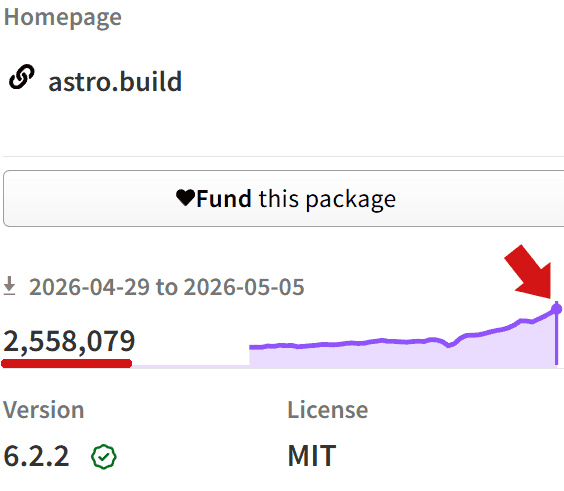
Astro had been steadily gaining popularity since it debuted in 2021. The idea that Astro is not popular and that the hoopla is loud voices is demonstrably false. Astro’s popularity is real. It is currently being downloaded at a rate of 2.5 million downloads per week. That’s a 100% increase from 2025 when it was being downloaded at a rate of 1.4 million weekly downloads.
Screenshot Of The Astro Download Statistics
Joost de Valk, founder of the Yoast SEO plugin, may have identified one of the reasons why so many people are turning to Astro. He recently wrote of an epiphany in which he realized he didn’t need a content management system (CMS); he just needed a website.
He wrote:
“For twenty years, ‘I want a website’ meant “I need a CMS.” WordPress, Joomla, Drupal: the conversation was always about which one. That framing is outdated. People never wanted a CMS. They want a website.”
Some Doubt The Astro Reality
Rayhan Arif, a WordPress business person, recently expressed his incredulity over the many tweets and blog posts by people sharing their experience leaving WordPress for Astro.
He tweeted:
“Every “’leaving WordPress’ post I come across seems to point to Astro. But when I dig a little deeper, I often don’t see any prior conversations or context showing those people were actually using WordPress in the first place.
To me, it starts to feel less organic and more like a coordinated narrative almost like a well-planned negative campaign against WordPress. It even makes me wonder whether some companies might be incentivizing this kind of messaging for their own business gains.
I could be wrong, but that’s honestly the impression I’ve been getting.”
That tweet seemed to imply that Cloudflare, which acquired Astro at the beginning of 2026, may have been orchestrating a whisper campaign. But nobody in that discussion agreed with him.
Astro Had Momentum Predates Cloudflare’s Acquisition
One of the first responses pushed back against the idea of a whisper campaign. Tommy J. Vedvik argued that the movement toward Astro was already happening before Cloudflare acquired Astro or created EmDash.
Vedvik responded:
“You’re probably wrong if you think it’s Cloudflare who’s behind it. This happened way before Cloudflare acquired Astro or created EmDash”
David V. Kimball made a similar point from his own experience, saying he had been encouraging people to move away from WordPress before Astro became part of a broader public conversation.
Kimball wrote:
“No, I’ve been pushing people away from WordPress to Astro before it was cool, starting about two years ago.”
He added that he had not seen many others doing the same until recently, but described himself as “a living breathing person” who had already helped many people make that move.
The pushback did not prove that every post was organic, but it did challenge the idea that the pattern began with Cloudflare. The replies suggested that Astro had already been gaining ground among some developers before the recent attention around EmDash.
Not everyone who left WordPress rushed toward Astro. Front end developer Tammy Hart shared that she was a WordPress defector but that she loathed Astro.
Longtime WordPress Defecting To Astro
Several respondents made a point of establishing their WordPress credentials. That became one of the thread’s strongest themes: the most detailed criticisms were not coming from people with no history in WordPress, but from people who said they had built careers, businesses, or client work around it.
Daniel Schutzsmith responded by identifying himself as both an Astro user and a long-time WordPress professional.
Schutzsmith wrote:
“Real Astro user here and I think you’ll see I’ve made 100s of sites with WordPress, been WCUS organizer 3 times, WCNYC organizer 2 times, and WCMIA organizer 1 time.”
Keanan Koppenhaver made a similar credibility claim, writing:
“Former VIP-agency dev, WP agency owner, current plugin owner and multi-time WordCamp speaker, here.
I’m using Astro for a lot now! Still WP in some cases, but Astro, especially when you’re working by yourself or with a git-knowledgeable small team, helps you move way faster.”
Mike Sewell acknowledged that he used both WordPress and Astro but that WordPress is no longer his go-to:
“I have been building client sites with WordPress since 2010. I still use it for some jobs, but I have found myself more and more reaching for other tools – nextjs + sanity, 11ty, and experimenting with EmDash. WordPress isn’t going anywhere but it’s no longer my go to.”
Many others shared similar backgrounds with WordPress, showing that there may be a movement from within the WordPress ecosystem that is moving away from WordPress.
The Matt Mullenweg Effect
While most users shared that the reason for leaving WordPress were pragmatic reasons like Astro’s performance and relative simplicity, Schutzsmith, the former WordCamp organizer who had built hundreds of WordPress sites, explained that his reason for moving away from WordPress was due to clients expressing skittishness about committing to WordPress after Matt Mullenweg’s actions which left hundreds, if not thousands, of WP Engine customers unable to update their WordPress websites. Related reading: wordpress user registration & membership plugin.
Schutzsmith shared:
“Matt steered it in a horrible direction and now it’s become very hard to sell WP to enterprise clients that literally see the drama he creates by seeing the articles and videos across publications and influencers about it.
That impact has not gone away. In fact, the monumental expansion of things like Claude Code and OpenAI Codex, make moving to a less dramatic, more stable content management system, a no-brainer.
Selling enterprise on JavaScript based solutions has become much easier than convincing that same buyer that their site won’t be affected if Matt has another meltdown.
The minute he said .org is his personal website to distribute plugins and themes, it made it no longer safe for the enterprise.”
Schutzsmith was speaking from professional experience, later explaining that six of his client’s websites hosted on WP Engine were disrupted because of actions taken by Mullenweg.
AI Coding Tools Are Making Astro Viable
Lastly, AI-assisted coding was one of the highest cited explanations for why Astro is receiving more attention now. Several replies in the discussion suggested that AI tools make code-first site development feel faster and less dependent on traditional CMS interfaces.
David Hamilton described Astro as a strong fit for Claude Code, writing:
“I use astro because it is ridiculously compatible with Claude code.
I haven’t had to open a CMS a figma board or anything.
My latest websites are all made through Claude and astro, I don’t see myself moving back to the traditional website builders anytime soon.”
There were many others who shared the exact same experience.
A Balanced View Of AI And Web Development
Yet there are others like Kevin Geary, developer of the Etch website builder, who express a nuanced opinion of using AI for creating websites.
In a separate post from several weeks earlier he wrote:
“A logical, evidence-based conclusion about where AI fits into a quality development workflow is: AI is a great tool for improving productivity but has to be heavily reviewed and steered by someone who actually knows what they’re doing.
If you’re in the 100% anti-AI camp, you’re likely taking a purely emotional position.
And if you’re in the “AI can do it all, run 18 agents at a time, coders are cooked” camp, you’re also taking a purely emotional position.”
Is The WordPress Ecosystem Eroding?
Anecdotal evidence indicates that WordPress veterans are leaving or minimizing their use of WordPress, largely because of the benefits of Astro, not necessarily because WordPress is a poor experience. Some are choosing Astro because it is faster. Others are using it because AI coding tools make code-first workflows easier and faster. Some are choosing it because their sites are mostly static, making WordPress somewhat overkill for their situation.
Then there are some who believe that the WordPress governance drama has become a business risk.
The larger story is not that Astro is replacing WordPress; it’s still too early to make that claim. The more important question is whether the turn toward Astro is a sign that WordPress has become overly complex and that it’s now easier to build with AI.
Ironically, on the other side of that argument, WordPress is on the verge of a major transformational change due to AI. WordPress version 7.0 is set to bring all the benefits of AI into WordPress at a scale that no other CMS or website-building framework can match. The massive community of plugin and theme developers is poised to roll out AI-assisted features that will be hard to compete against.
Featured Image by Shutterstock/yulsiart