


A conversation is happening in every enterprise right now, and most CMOs and CIOs do not realize they are talking past each other. The rise of AI agents is prompting new collaboration between marketers, AEO strategies, and leadership.
When the CIO hears “AI agents,” they think about the productivity rollout. Copilot seats, agentic workflows, internal automation. When the CMO hears it, they think about ChatGPT, Perplexity, and whether the brand is cited when a customer asks an AI a question. Same phrase. Two entirely different problems. The gap between them is now a revenue problem.
The CMO needs the site ready for AI-driven discovery, recommendation, and purchase. The CIO, if the site is not configured for that world, is unintentionally blocking it, treating new agent traffic the way IT teams once treated scrapers and bot noise. That is the big, potential friction point I see both in conversations and in recent research, which I will share in this article.
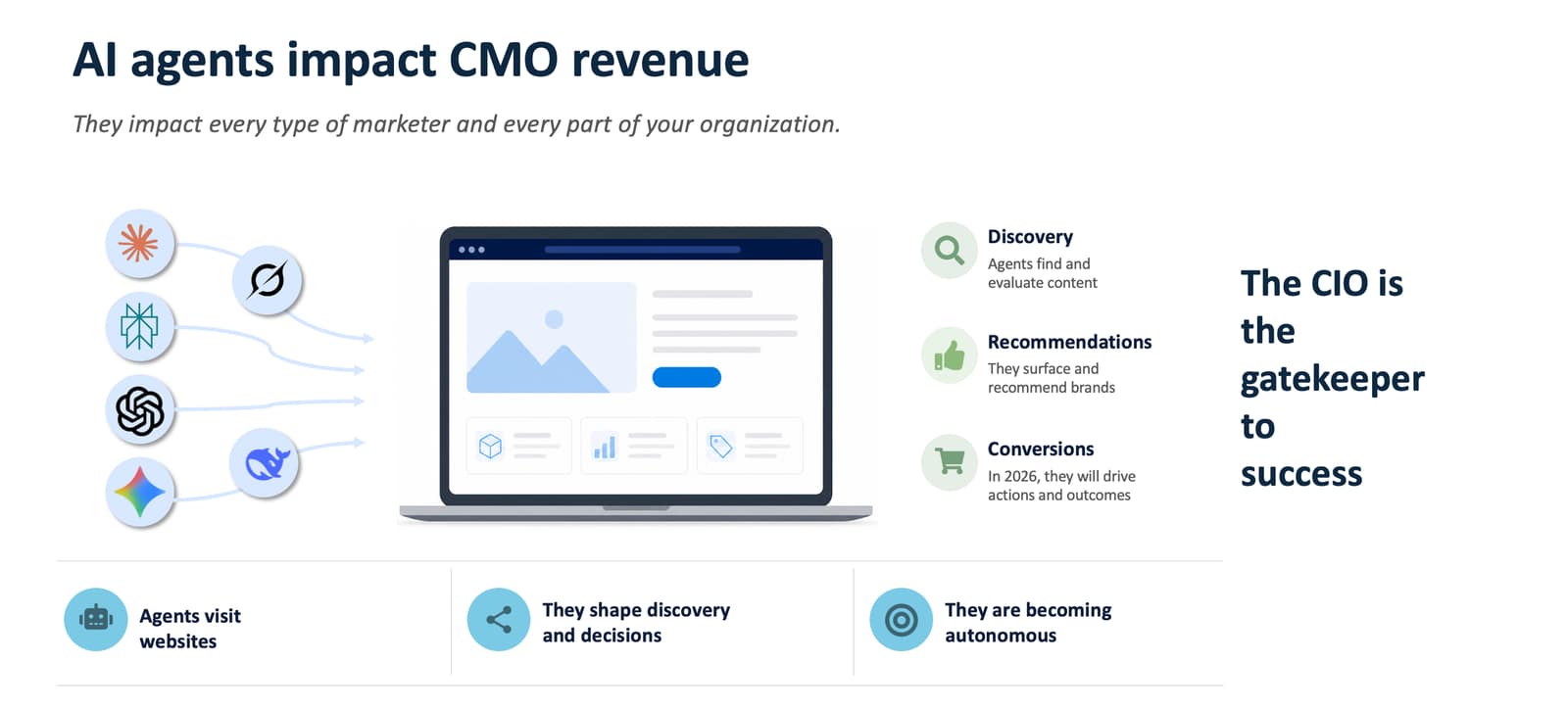
Brands have spent two decades engineering websites for human visitors and now must design for two audiences in parallel – humans and the AI agents acting for them. The implication for the CIO is uncomfortable but worth saying. If your robots.txt or your firewall is keeping modern AI agents out, you are not screening bots. You are turning away customers and making it harder for the CMO and marketing teams to hit their brand-building and revenue targets. And that impacts every department and function within your organization.
Three AI Agent Layers Every Brand Needs To Recognize
Before the CMO and CIO can align, both need the same mental model. Your website has three new types of visitors. None are human, but everyone is working on behalf of one. The generic phrase “agentic AI” papers over a distinction that matters.
AI Crawlers And Agents
GPTBot, ClaudeBot, PerplexityBot, Google-Extended, and others. These are future customers arriving through AI. They pull content in real time for live conversations, not for later indexing. They need fast, structured, machine-readable pages.
AI Browsers
Perplexity Comet, OpenAI Atlas, Chrome with built-in AI. These see pages on the user’s behalf, compare products, fill forms, initiate purchases. If your pages are not machine-readable, the agent may move on.
AI Assistants
ChatGPT, Claude, Gemini. The human still asks the question and reads the answer, but the line between “assistant” and “actor” is blurring fast.
Explaining the impact should be simple, but often gets lost in abstract conversations: AI is talking about your brand right now, deciding if it can find and cite your content, shaping how consumers perceive and buy from you, and assisting people through research, discovery, and purchase. None of that is internal productivity. All of it is revenue-adjacent.
All three layers matter, but the rest of this article focuses on the first, AI crawlers and agents. They are the layer hitting your website and content right now, the one most CMOs and CIOs are mislabelling, and the layer where today’s policy decisions open or close the door to AI-driven revenue. Browsers and assistants build on what this layer sees.
The AI Agent Surge: What The Shock Signals For Unprepared Brands
According to internal data, between November 2025 and March 2026, AI agent activity is up 150% month-over-month, and 88% of visits from search are now AI agents. AI agents are 15% of all website traffic – agent activity is on course to overtake human-driven search before the end of 2026.
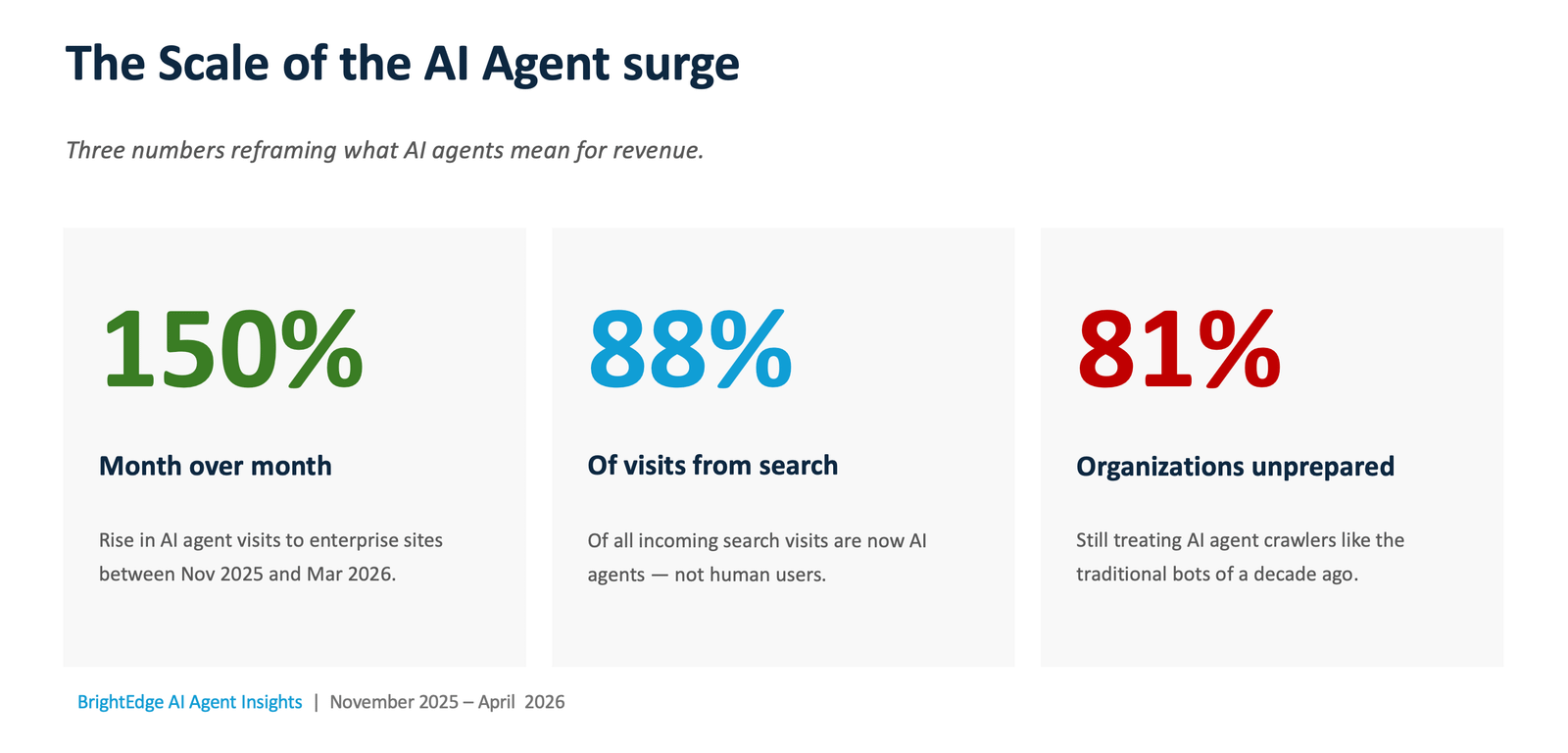
The number that should shock most CMOs and marketers at the leadership level: 81% of organizations are filing AI agents under the same bucket as the bots of a decade ago, with access rules written for a different era of the web.
The AI Crawler Mix Reshaping Search
From the internal data, the crawler mix tells the rest of the story.
- ChatGPT’s user agent now accounts for more than 96% of AI user bot traffic, hitting sites in real time on behalf of consumers.
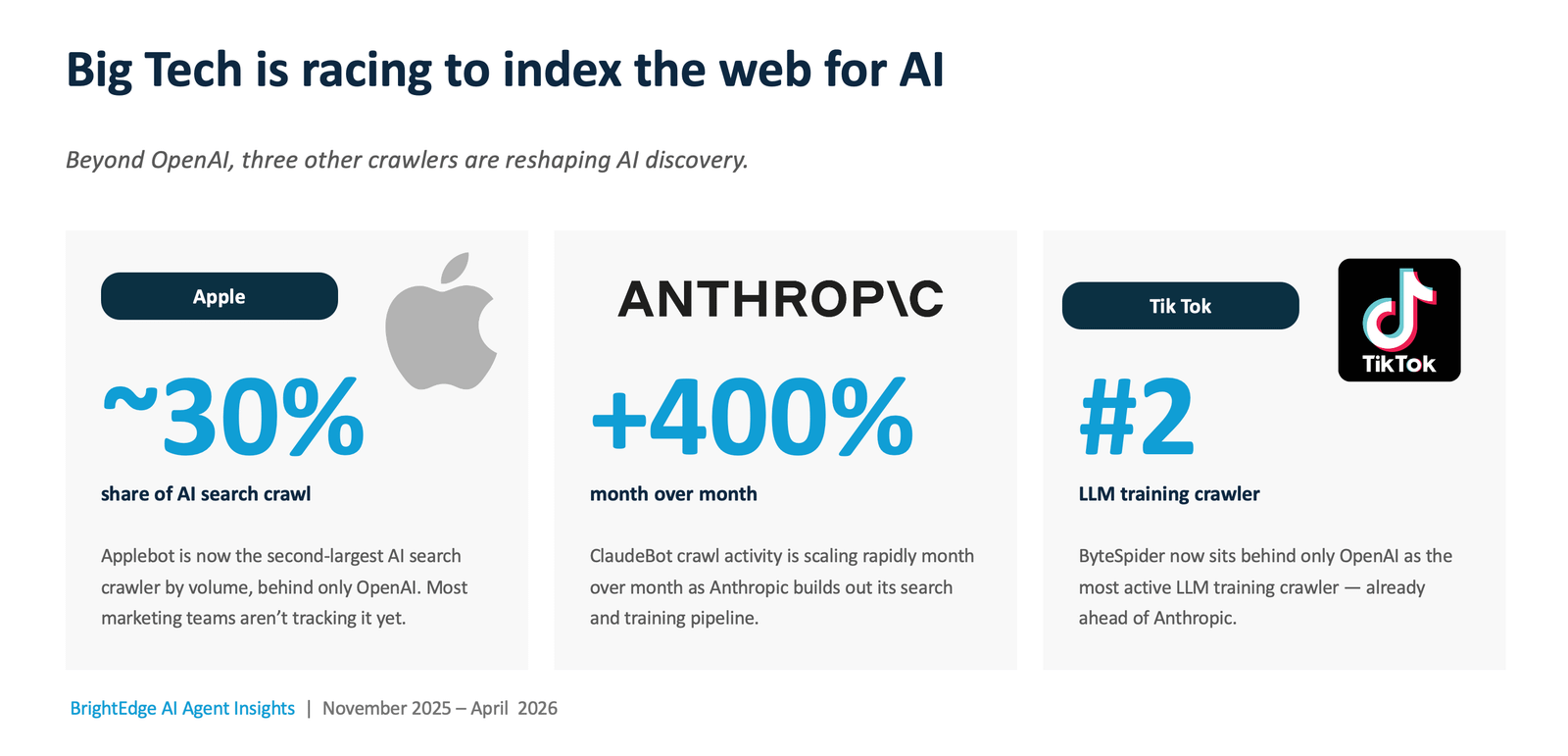
- GPTBot represents roughly 55% of AI training crawl volume, and OAI-SearchBot about 47% of AI search crawl activity. OpenAI is dominant across all three layers.
- Applebot accounts for about 30% of AI search crawl activity, and most search and marketing teams are not tracking it.
- ByteSpider, the crawler behind ByteDance’s AI products, grew 138% over the tracking window.
- ClaudeBot surged 800% between November and December 2025. AI training does not follow a linear schedule; log analysis after the fact is no longer enough.
- Google NotebookLM grew 144% in the same window, as researchers and knowledge workers increasingly use it to pull live content on their behalf. And now Gemini user agents are surging.
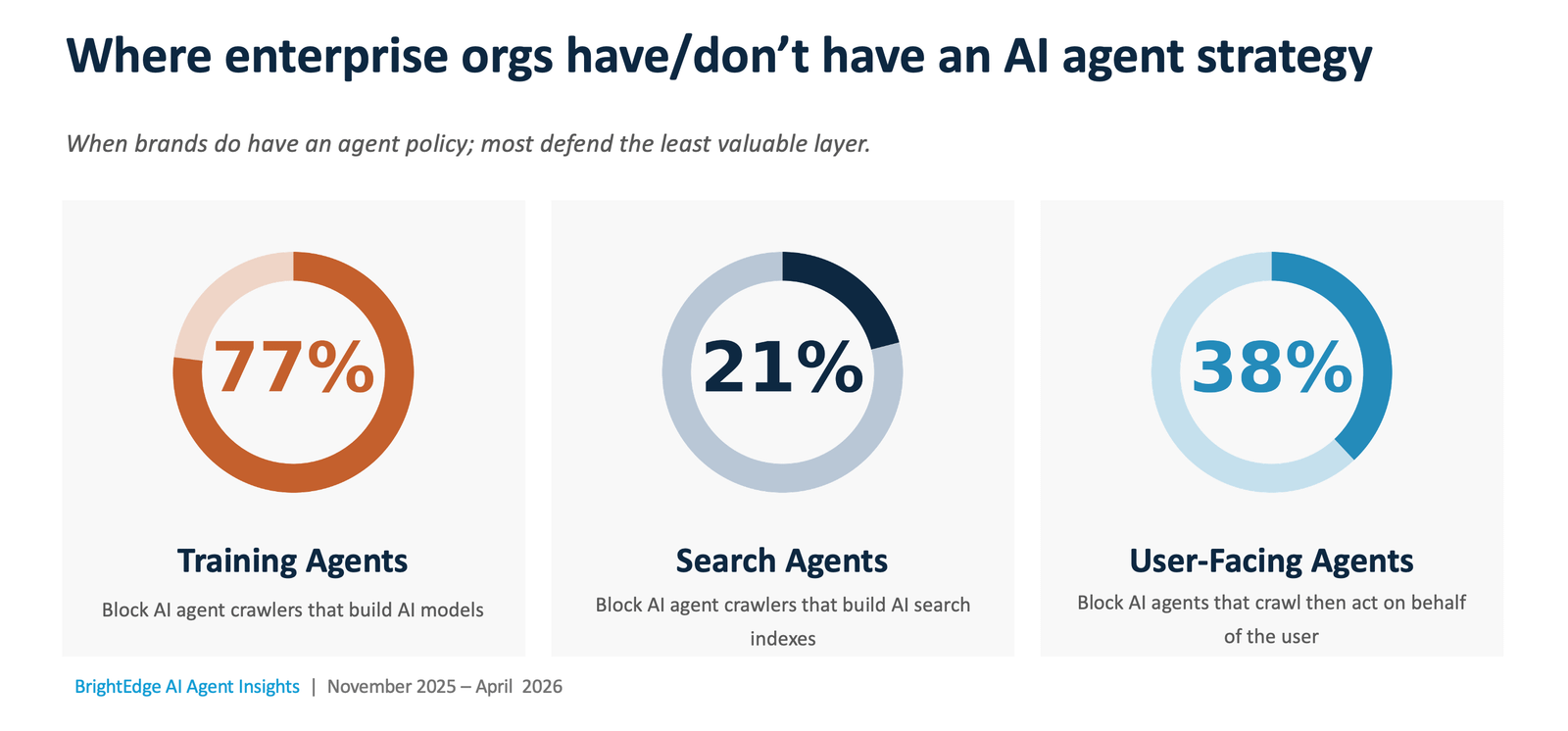
Of the 20% of brands with any agent policy set, 77% only block training crawlers. That is a publisher move: protect content from being learned by an LLM. For a brand, the trade is different. Block training and the models never learn your story, and you hand the narrative to a competitor.
Just 21% have built any strategy for the search-side crawlers like OAI-SearchBot, and only 38% have any approach to the user-facing agents browsing a site live on a customer’s behalf. Most companies are fortifying the surface that matters least for revenue and leaving the two that matter most without a strategy at all.
The $40 Billion AI Agent And Search Opportunity At Stake
The cost of getting this wrong is not theoretical. Even if 80% of companies manage their AI agent policies correctly, the remaining 20% still leaves an estimated $40 billion of search opportunity on the table across the wider economy.
AI Agent Success Beyond The SEO Box: The CMO And CIO Friction Point
Why AI Agents Now Sit Between Marketing, IT, And The Digital Team
Managing AI agent access has moved well beyond “just the SEO function.” It now belongs jointly to marketing, IT, and the digital organization, and the brands moving fastest are the ones treating it that way. The importance of AI agents and AEO needs to be highlighted clearly to the CMO and CIO.
CMOs need clarity on how agents are shaping discovery and the brand impression customers walk away with. CIOs need to look again at bot policy and access controls through a revenue lens, not just a security one. And SEO and digital leaders need to make sure the pages that drive consideration and conversion are findable, machine-readable, and current enough for a machine to act on. None of those three roles can deliver the outcome alone.
AI Engines As Brand Editorialists
There is a second layer CMOs should not miss. The same AI engines sending agents to your site are also forming opinions about your brand and serving them back to customers as answers. AI engines now act as editorialists, each one summarizing your brand a little differently, and that summary is often the first impression a buyer ever forms of you. Tracking how each engine talks about your brand has stopped being a research curiosity. It is now a revenue safeguard, and it sits inside the same agent-readiness conversation.
The AI Agent And AEO Readiness Gap: Why Most Teams Are Stuck
The surge data tells you what is happening. Our latest research and survey data tells you why most companies are stuck.
Over the past three months, we ran a survey of just over 1,000 enterprise digital and search marketing leaders, asking honestly how ready they feel for the AI agent and AEO shift. The AI agent and AEO and CMO and CIO gap is consistent: awareness is broad, ownership is unclear, and almost nobody can prove they are ready. For more on this, see our microsoft just proved a point about search today guide.
4 AI Agent And AEO Data Points Every CMO And CIO Should Sit With
- Only 19% could confidently answer “yes, we are ready, and I can prove it” if the CMO walked over and asked them today. Half are still working on it or are unable to explain the gap upward.
- 75% have no documented plan or named owner for the question.
- 72% told us marketing has ended up owning AI agent and AEO responsibility without ever being formally handed it. Only 17% report IT or engineering owns it.
- 56% of the last conversations marketers had with IT or security stalled, were blocked, got filed away as “just SEO,” or were actively avoided.
That last point highlights the CMO-and-marketing vs CIO-and-IT friction point I mentioned earlier. Marketing has been handed an executive communication and infrastructure-adjacent problem. IT, focused on internal productivity agents, treats site-visiting agents as background bot traffic. Security treats them as a risk to filter. Nobody is jointly owning whether AI agents can find, read, and cite the website paying for everyone’s salaries.
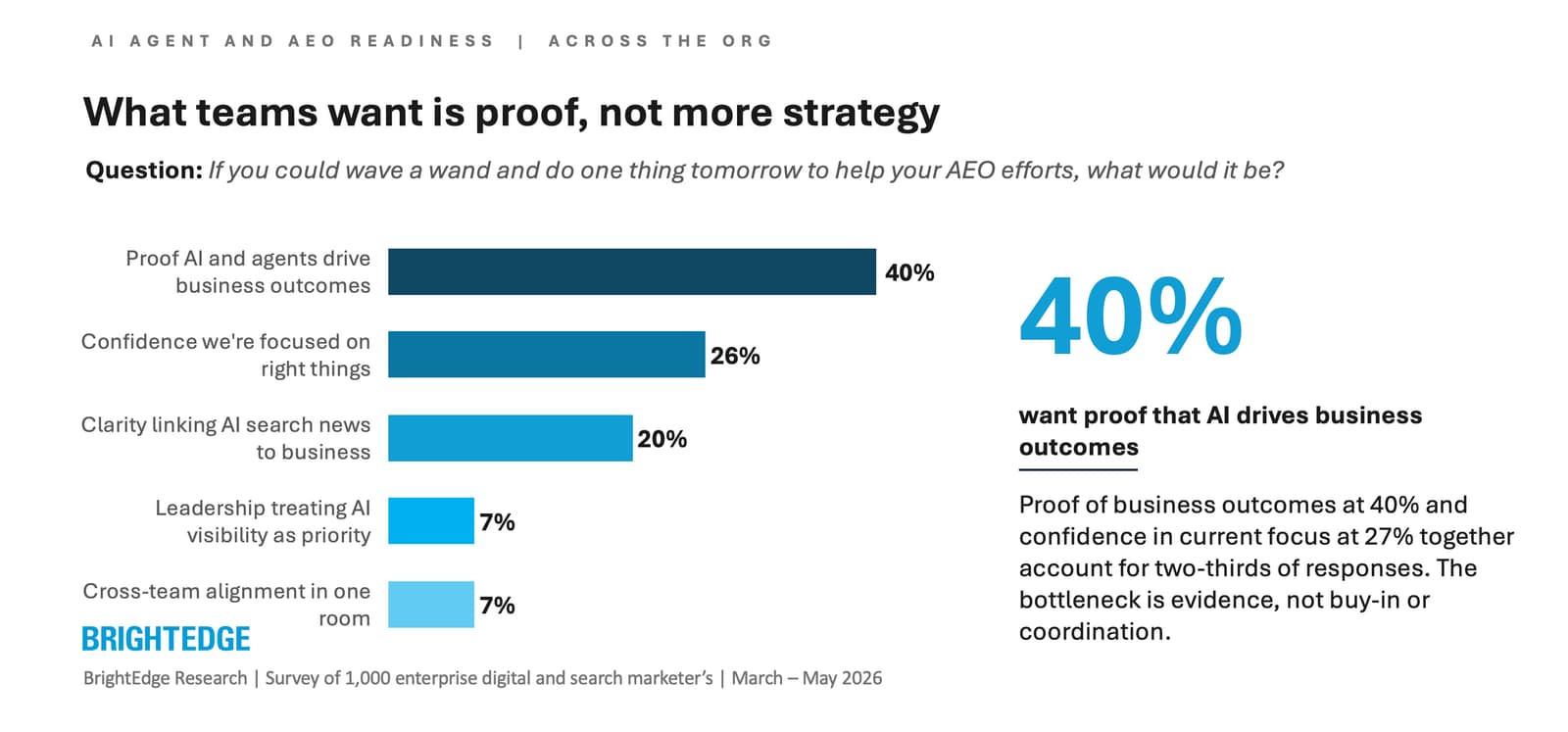
What Teams Actually Want Is Proof Of AI Agent And AEO Success, Not Strategy
When we asked what one thing teams would change tomorrow, 40% gave the same answer – proof AI is driving business outcomes. Not more strategy. Not more screenshots. Not more buy-in. Evidence.
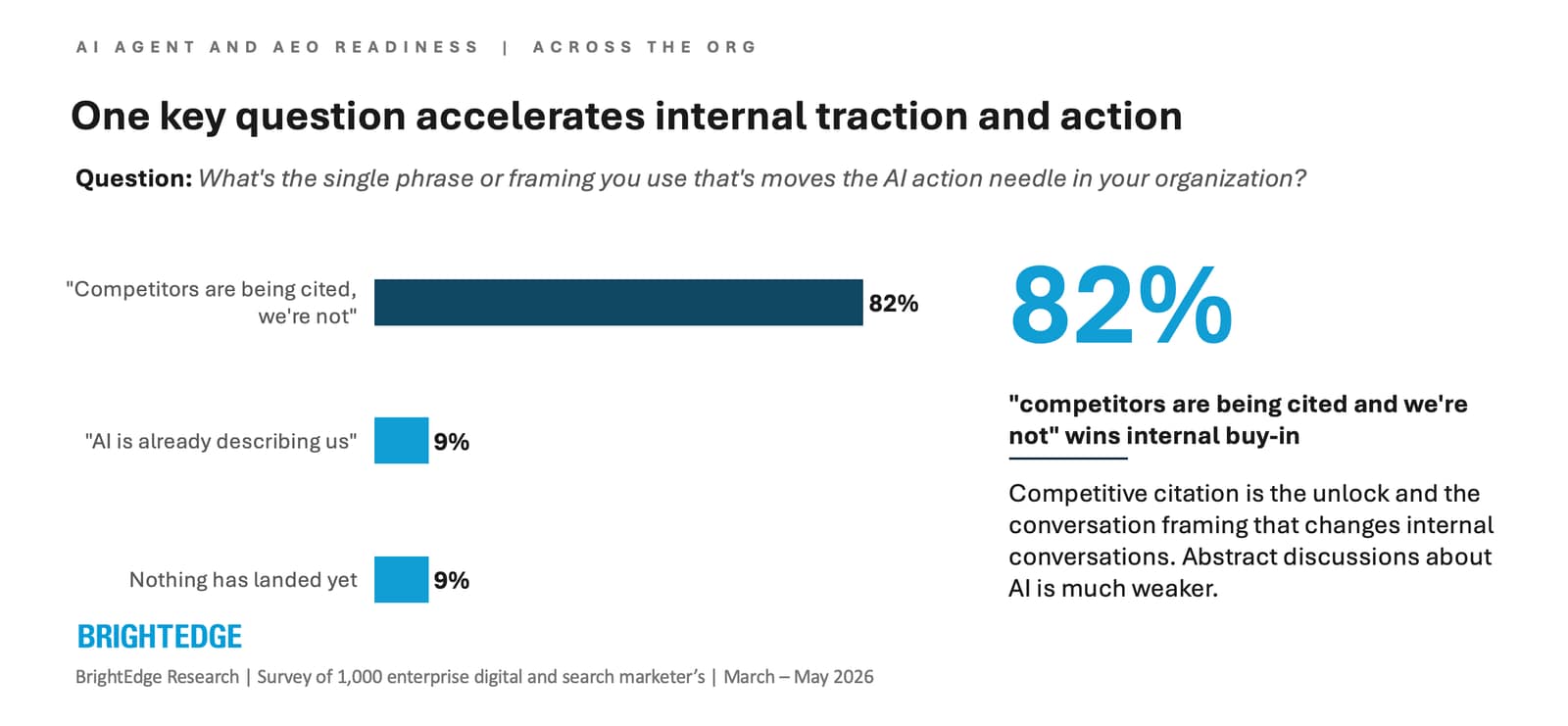
Abstract AI conversations on AI agents and AEO do not move CMO and CIO boardroom movement. Competitive success comparison does.
What CMOs, CIOs, And Marketing Teams Should Do Now With AI Agents
From my experience as a CTO myself, working with large brands and enterprise marketers at all levels, and pulling the surge and survey data together, here is what I would put on the next CMO-CIO sync.
For the CMO. Stop describing AI agents in the abstract. Pull the competitive citation picture. Show the board which competitors are being cited by ChatGPT, Perplexity, Google AI Mode, and others in your category, and which prompts you are missing from. That is the conversation that funds the work.
For the CIO. Recognize there are two distinct AI agent conversations inside your organization: one is internal productivity, the other is external discovery, commerce, and brand visibility. They do not share owners, and treating site-visiting agents as standard bot traffic is now a revenue problem, not a stack-hygiene issue.
For marketing and search teams. Get the measurement layer in place before that CMO question shows up. “Still working on it” will not survive a boardroom. Set explicit policy for each of the three agent layers (training, search, user-facing) and write it down. Block only training crawlers, and you defend the least valuable surface while leaving the two most valuable ones exposed.
3 AI Agent Questions For Your Next CMO-CIO Sync
- Who owns whether AI agents can access, read, and cite our site, and is that ownership documented?
- What is our explicit policy for training, search, and user-facing agents?
- How are we measuring AI citation, brand presence in AI answers, and the business outcomes tied to AI discovery?
Answer those three, and the friction point starts to dissolve. The AI agents and AEO and CMO and CIO readiness gap is not really an awareness gap. Awareness is fine. It is a gap in cross-functional ownership and evidence. Close those two, and alignment, prioritization, and formal plans tend to follow.
The brands that get past the CMO-CIO friction point first are the ones that will be cited when it counts.
More Resources:
Featured Image: Anton Vierietin/Shutterstock
All data above is taken from Brightedge internal data, unless otherwise indicated: AI Agent Insights, November 2025 – March 2026, AI Agent and AEO Readiness Gap survey, March – May 2026.