


This month’s Ask a PPC tackles a strategy question masquerading as an execution one:
“What should search campaign structures look like when AI changes how people research before they buy?”
AI has created meaningful changes in how people consume information. Importantly, buyers increasingly arrive more informed and qualified, with clearer expectations shaped before they click. Yet the core of marketing has not changed. You still need to understand who your target audience is, why they would choose you, and how to make it as easy as possible for them to do business with you.
If those three things are solid, AI-era campaign structure becomes less about rebuilding everything and more about making sure your account can do three things well:
- Connect with the right humans, regardless of whether they search or interact in ways legacy keywords can reach.
- Pass back enough meaningful conversion data to help AI bid and prioritize effectively.
- Support the ways buyers now prefer to research and transact with assets that can flex on different surfaces.
Disclosure: I work for Microsoft. This article is intended to be platform-agnostic and focused on practical campaign strategy.
The biggest shift is that because AI can better infer intent and answer multi-part questions, people are now asking longer and more complex questions.
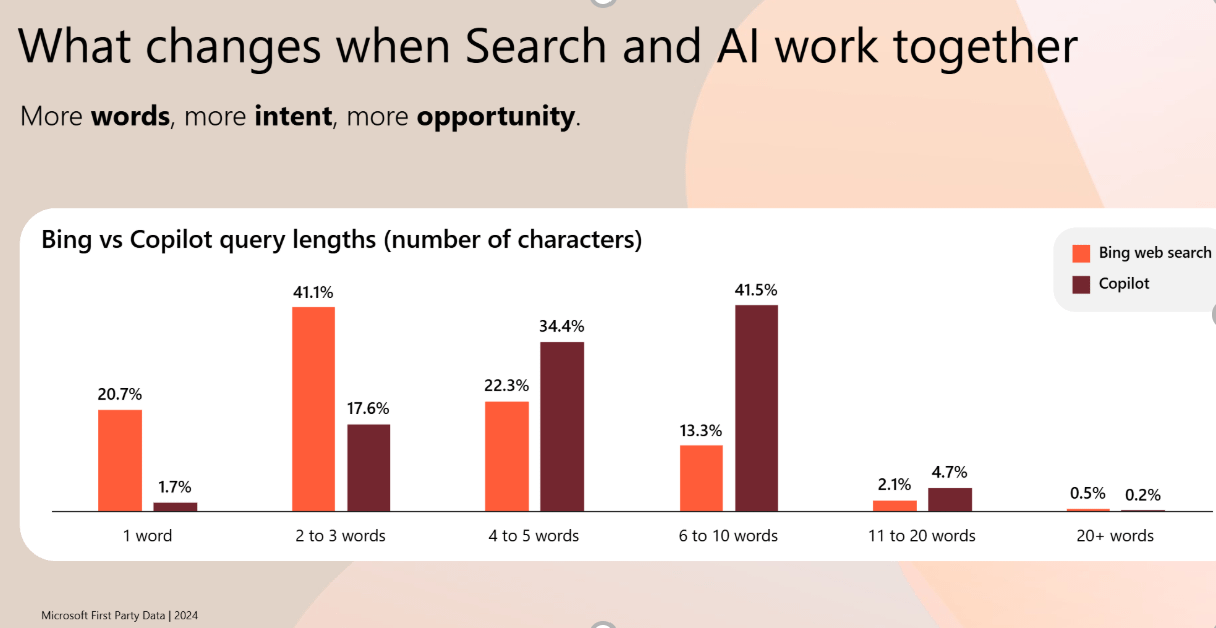
In the past, a searcher might type two or three words, scan a page of links, and do the work of comparing options themselves. Now, people are more likely to add context upfront. They expect answers that are more useful from the first interaction, whether that happens on a search results page, a website, a video, a social platform, or an AI-assisted experience. Related reading: how to optimize PPC accounts with less search term.
That means buyers may arrive more informed, with clearer expectations and less patience for friction. Account structures built around tightly controlled keyword paths and static ad sequences are less suited to that reality.
For advertisers, that changes the structure conversation.
The question is no longer:
“How do I configure campaigns around keywords and static ads?”
It becomes:
“How do I organize campaigns for more informed buyers while giving the platform enough conversion signal, flexible creative, and budget to support the business goal?”
That leads to three practical structure decisions.
1. Connect With The Right Humans Through Intelligent Segmentation And Consolidation
As buyers ask longer and more complex questions, the exact keywords they use become less important than the underlying need they are trying to solve.
Historically, advertisers often structured campaigns around tightly grouped keyword themes because keyword choice was one of the strongest indicators of intent. Today, AI systems are better at recognizing similar intent across a much broader range of queries and customer journeys.
This is where message mapping becomes more important, not less.
Only you know your brand voice, strongest proof points, margins, and why one customer segment matters more than another. AI can identify patterns and match people to messages, but it cannot decide which customers are most valuable, which products deserve priority, or which proof points make your offer meaningfully different.
Those strategic decisions should influence structure; more importantly, when to segment based on a business need or consolidate to honor AI campaign types.
Not every difference deserves a separate campaign. Segmentation still makes sense when it protects a real business need, such as:
- A dedicated budget for a strategically important product or service.
- A separate performance target, especially when high-value and high-volume initiatives should not compete for the same spend.
- Different compliance, legal, or brand requirements in creative. For example, Microsoft Advertising disclaimers are set at the campaign level and must appear with the ad in order to serve.
Outside of those practical constraints, consolidation is often better suited to the AI era. Informed consumers may move from a broad comparison to a specific feature, price, or proof-point query without following the neat funnel implied by a legacy account structure. Consolidation keeps more relevant conversion data together, helping AI-supported bidding and matching evaluate those customer access points (be they traditional query or something else) without splitting performance learnings and signal across campaigns that individually have too little budget, traffic, or conversion volume to optimize reliably.
The goal is not fewer campaigns for the sake of fewer campaigns. It is enough separation to protect legitimate business requirements, with enough consolidation to maintain conversion density and give the system room to drive performance effectively.
Before Choosing Either Approach, Ask:
- Does this segment need its own budget, performance target, or creative requirements?
- Do these products or audiences support the same conversion goal?
- Will each campaign have enough budget, clicks, and meaningful conversions to learn?
- Could shared conversion data and assets help the system respond more flexibly?
- Will reporting still show which parts of the business are driving performance?
Human strategy remains essential because humans determine which differences matter enough to warrant control and which differences simply reduce the platform’s ability to connect the right message to the right buyer.
2. Make Conversion Data Part Of The Structure To Ensure Intended Budget Allocation
More informed buyers do not always follow the simple paths legacy account structures were built to measure. AI-supported bidding can only respond to those varied journeys through the signals advertisers provide, especially conversion data. If the signal is thin, incomplete, or misaligned with the business goal, the campaign may optimize toward activity that looks efficient but does not serve the business.
This is especially important when deciding whether to segment or consolidate.
A separate campaign may seem easier to report on or control, but informed buyers can cross product, feature, and content boundaries before converting. If each segment does not generate enough meaningful conversions (30 in 30 days), the platform sees fragments of that journey rather than a usable pattern. Consolidation can help niche accounts reach the conversion density AI tools need to make better choices.
Conversion tracking can be done through conventional tags or through offline uploads. If you know you’ll be working with uploads, make sure you build in enough time for the campaigns to ramp up while that data is coming in.
While ecommerce brands live and breathe by return on ad spend, lead gen brands sometimes leave value-based bidding to the side. This is depriving the platform of the most useful way to prioritize where your budget goes.
Conversion Values Matter Because Not All Conversions Are Equal. For Example:
A low-cost lead is not automatically a good lead. While it may have been able to meet CPA goals due to cheaper CPCs, the actual lead might be a lower-probability customer (or not a customer at all).
This is why adding conversion values is critical for AI-oriented structures. By passing along a higher or lower value, conversion-based bidding can prioritize higher-value actions and make more intelligent guesses on the probability an auction will be worth bidding on.
Additionally, it’s important not to mix too many conflicting goals in the same campaign. Doing so can make it harder to get enough volume behind entities in your campaigns that need volume, or save enough budget for high-value leads/sales.
Before Finalizing Structure, Ask:
- Which conversion actions actually matter?
- Are we passing back value where value differs?
- Does each campaign have enough signal to learn?
- Are we separating campaigns because the business needs separation?
- Are we asking a small budget to support too many targets?
3. Build With Flexible Asset Consumption To Reach Your Customers When They’re Ready To Do Business With You
AI-era structure isn’t limited to campaign counts and budgets. Because buyers may encounter your brand after doing substantial research elsewhere, every asset needs to answer the question that brought them in and be capable of selling you on its own.
Headlines, descriptions, images, landing pages, and other assets need to support different moments in evaluation. They also need to make sense in isolation or in different combinations across placements and formats; an informed buyer should not have to reconstruct the basics before assessing your value.
Audit Your Assets With Practical Buyer Questions:
- Do you explain what you do?
- Do you make it clear who the product or service is for?
- Do you leverage price as a pre-qualifier for high-ticket items/services or an invitation for lower-priced offers?
- Do you back up your claims with trust signals like reviews and third-party mentions?
- Do your landing pages continue the promise your ads make?

AI-powered assets are the key to continuous creative optimization and ensuring that you’re always serving the most relevant creative to users based on the signals we know and the context of their queries. Microsoft internal data shows that AI-assisted assets bring an average 5% click-through rate over their manual counterparts. It’s important to provide the system with enough variation so AI ad types can dynamically compose the right creatives based on the signals the platform has access to.
Balancing this creative assist with tools like disclaimers, brand guidelines, and message constraints ensures the needed flexibility to participate on AI surfaces while honoring business needs in creative and structure.
Final Takeaway
AI has changed how people research, which means buyers often arrive more informed than the account structures built around older search behavior assume. It has not changed the fundamentals of good marketing. See also: the top 10 digital marketing trends for 2026. Related reading: linkedin shares key trends in B2B marketing.
You still need to know who you are trying to reach, why they would choose you, and how to make action easy.
What has changed is the amount of context buyers bring, the paths they take, and how quickly they expect useful answers. Campaign structure needs to support that reality rather than force those buyers through rigid keyword, message, and landing-page paths.
Strong AI-era PPC structures do three things well:
- They map messages to the humans they are meant to help.
- They give campaigns enough conversion signal to learn.
- They protect control where control serves a real business need.
If you understand the informed buyer, the business goal, and the signal each campaign needs, you can replace legacy structure for structure’s sake with intentional control and useful flexibility.
See you next month for another question on Ask the PPC!
More Resources:
Featured Image: Paulo Bobita/Search Engine Journal
1 Comment
Build A Live Data Stack With MCP For Smarter Campaign
September 12, 2026[…] Instead of one Project per client, an in-house team typically builds one Project per function or workflow. A paid search Project holds the brand’s campaign structure, naming conventions, bidding philosophy, and target metrics. When that Project is connected to Google Ads via MCP, a question like “which campaigns are pacing over budget this week and which are under-delivering against impression share targets” becomes a two-second query rather than a 20-minute reporting exercise. A content Project holds the brand voice guide, approved messaging frameworks, and the current content calendar. A reporting Project knows the stakeholder who receives the report, what they care about, and what format they expect. See also: how AI search trends are changing PPC campaign structures. […]