


Over 15 years ago, it was widely accepted that the benchmark click-through rate on a non-brand campaign was 2%. In fact, that number was so deeply embedded into paid search that it is unclear if anyone ever stopped to recalibrate and define a new metric to reference across all accounts.
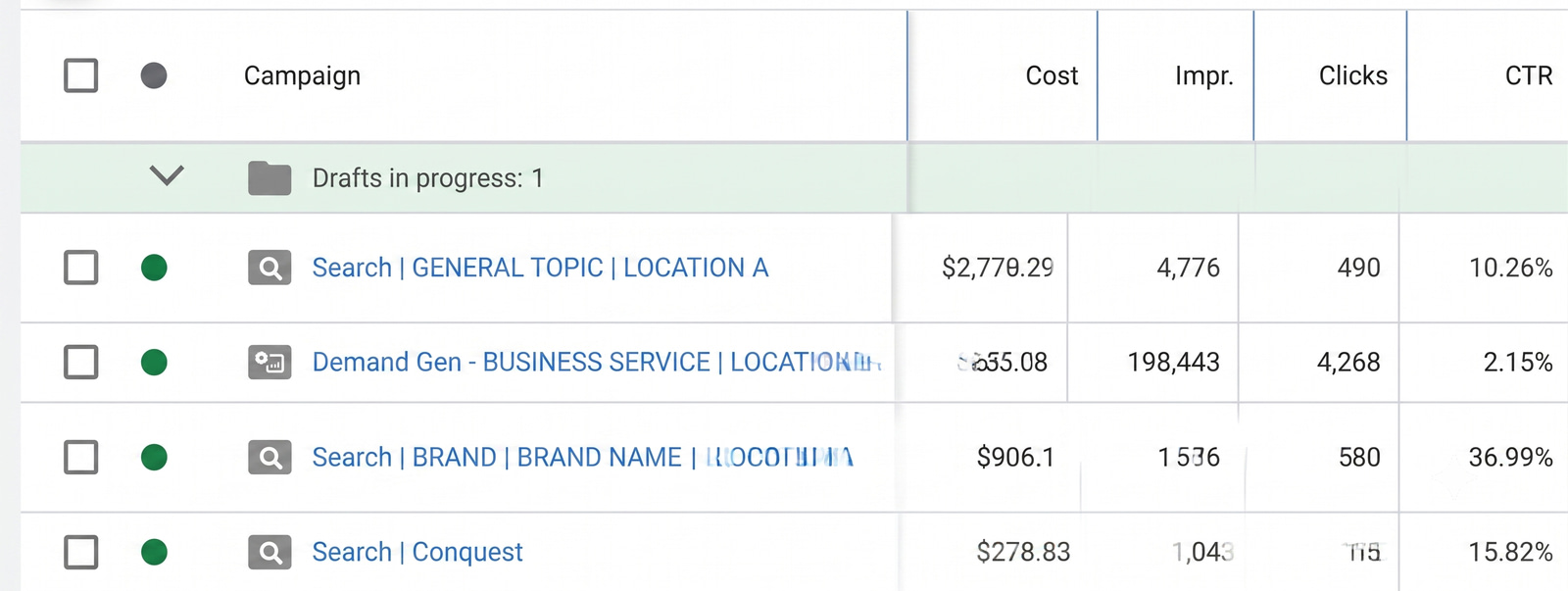
This is why, in 2026, when we see CTRs like those in the example account below, it is easy to say, “the ads are working” or “that number shows that the ads are resonating.” However, given modern bid strategies and the increasing freedom we grant to AI, it is important to take a step back and examine what CTR looks like today, and whether it truly signifies that an ad is successful.
Redefining The CTR Equation
CTR is the mathematical equation of clicks divided by impressions, and it is the data point that determines if your ads are being clicked. Contextually, CTR has always required some differentiation. A brand search campaign should yield the highest CTR, a non-brand search will sit at a mid-tier CTR, and a conquesting or competitor campaign will fall on the low end of the search spectrum.
But with automated bidding, CTR isn’t that simple. It is no longer a straightforward calculation of clicks divided by impressions because of how different bid strategies operate. For instance, if an advertiser runs a Maximize Conversions or Maximize Conversion Value bid strategy, impressions are restricted to a specific subset of searchers the AI believes are most likely to convert. Conversely, a Target Impression Share bid strategy will pull in a larger volume of impressions, increasing the denominator and resulting in a lower CTR. Meanwhile, a Maximize Clicks strategy specifically favors users with a high propensity to click. All of these points to the fact that we cannot simply state that a high CTR means the ads are resonating. The metric is no longer as pure as it was in the early days of PPC marketing.
The Impact Of Campaign Architecture
Another layer that requires consideration is the campaign type or subtype. For example, Display, Demand Gen, and YouTube campaigns will inherently have remarkably lower CTRs because those formats are not primarily designed to drive immediate clicks. Furthermore, Performance Max campaigns across both Google and Microsoft inherently drive a highly mixed CTR due to their multi-channel nature.
Does A Healthy CTR Equal Success?
With a firm understanding of CTR’s technical definition and its historical evolution, we must address the ultimate question: Does a healthy CTR actually indicate that your ads are successful? Regrettably, the answer is no. A high volume of users clicking your ads does not inherently equate to a winning campaign. In the world of performance marketing and PPC, “success” is traditionally synonymous with revenue generation, yet it is increasingly vital to view performance across a broader spectrum.
While a click is not a guaranteed sale, it is the initial spark of opportunity. In our modern era of automation, CTR has shifted from a primary success metric to a diagnostic indicator. Where it once gauged raw human interest, it now serves as a proxy for AI efficiency. On today’s performance spectrum, a shifting CTR is often just a byproduct of the algorithm testing various audiences, placements, and creative iterations.
Ultimately, a robust CTR confirms that your messaging is potent enough to win the auction and cut through the noise, but that is only one piece of the puzzle. Rather than evaluating AI solely on its ability to generate clicks, we must judge it based on the quality of the actions occurring post-click. If your conversion rates are improving and your cost-per-acquisition is trending downward, a fluctuating CTR isn’t a red flag; it’s evidence that the AI is performing its intended function: filtering out the noise to identify your true buyers.
Moving Beyond The Click
Another rapidly accelerating variable is the integration of generative AI within the search engines themselves as new ad formats roll out. Features like Google’s AI Overviews are designed to resolve user intent directly on the results page, inevitably giving rise to the “zero-click search.” To complicate matters further, the ad platforms have yet to provide a standardized, transparent definition of how impressions and clicks generated inside these generative AI blocks are mathematically aggregated in our standard reporting dashboard. We are essentially measuring a shifting target.
The Final Verdict On Modern CTR
Ultimately, a healthy CTR is a sign of life, not a guarantee of success and performance. It proves your creativity can win the auction and that your brand can find real estate in a generative search layout, but a strong CTR doesn’t promise a return on investment. As the PPC landscape continues to evolve, stop asking whether your ads are getting clicked, and start asking what those clicks are actually buying you. Let the AI manage the math of the CTR spectrum for your ad account and allow you to manage the revenue. See also: AI gives you the vocabulary. it doesn’t give you the.
More Resources:
Featured Image: Roman Samborskyi/Shutterstock